WHEN SHE WHISPERED “MY FATHER… THREE TIMES A DAY,” THE RANCHER SWORE AN OATH THAT SHOOK THE WEST
PART 3 — THE WOMAN WHO WALKED OUT OF THE DARK
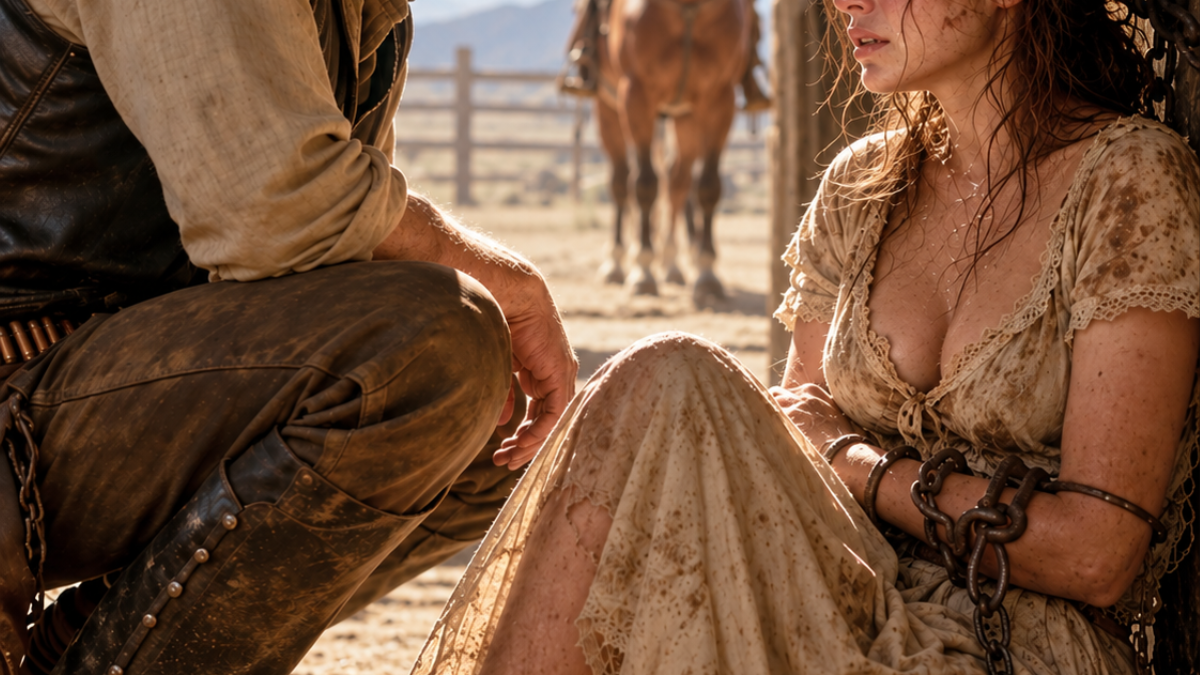
Nettie entered the Salina courthouse wearing the same dress she had worn in the cellar.
Maeve had offered her another, but Nettie refused because she wanted the judge to see exactly what forty-seven days looked like.
Her wrists were still bandaged, Ruth’s journal was tucked against her chest, and behind her walked Josiah, Maeve, and Levi—not leading her, not rescuing her, simply refusing to let her stand alone.
Judge Arthur Waverly entered at eight sharp. He already had Slade’s petition claiming Nettie suffered from melancholia and lacked the mental capacity to control her property.
But now he also had a twenty-two-year-old woman standing before him demanding to be heard.
Nettie gave him everything. The first night in the cellar. The rope around her wrists.
The iron ring. The starvation. The forced deed. The forty-seven marks. Then she placed Ruth’s journal before him.
Waverly opened it. Page after page carried dates, names, injuries, threats, witnesses. Ruth had documented the collapse of her marriage while quietly protecting the property Harlan desperately wanted.
One entry described Harlan smashing furniture and threatening that if Ruth ever escaped him, he would make certain Nettie never did.
Ruth died six months later. Then Harlan turned on their daughter. Nettie also produced sworn statements.
Dr. Hensley admitted treating Ruth for injuries he knew had not come from accidents. Reverend Pike admitted witnessing Harlan strike her.
mrs. Aldridge confessed she had heard Nettie’s screams after the cellar door closed. Then came Nettie’s strangest weapon.
A handwritten list. Names. Dollar amounts. Gambling debts. Waverly asked where she had obtained it.
Nettie told him. For forty-seven nights, Harlan had sat above the cellar drinking and talking to himself.
He recited debts, deals, grudges, and plans while believing his daughter was powerless beneath his boots.
She had memorized all of it. Harlan had given her forty-seven days to build a case against him.
Waverly was still examining the documents when the courthouse door opened. Emmett Slade entered first.
Harlan followed. Nettie rose instantly. For one terrible second she was no longer inside a courthouse.
She was underground again, hearing his boots overhead, waiting for the lock. Then Levi shifted beside her.
Maeve stood on her other side. Josiah remained behind her. Nettie looked at Harlan again.
And the cellar vanished. Slade smiled and offered a settlement. Harlan would withdraw the competency petition if Nettie surrendered the property and abandoned every criminal complaint.
Harlan called it peace. Nettie called it what it was. Escape from consequences. Then Harlan made his mistake.
He invoked Ruth. “Your mother would’ve wanted us to fix this.” Nettie’s entire body went rigid.
She stepped toward him. Her voice became dangerously quiet. He was never to use Ruth’s name to excuse what he had done.
Ruth had recorded him because she feared him. She had separated the water rights because she understood him.
She had prepared protection for Nettie because she knew exactly what might happen after she died.
Harlan had not lost his family. He had destroyed it. Slade warned Nettie that emotional behavior would hurt her case.
Nettie turned toward him. “That wasn’t an outburst. That was testimony.” Judge Waverly returned before Slade could answer, accompanied by Dr. William Harmon.
The judge ordered Harlan outside and instructed Harmon to conduct an independent competency examination. Nettie refused privacy.
She wanted witnesses. She wanted a record. She wanted no room left for another man to rewrite what happened.
For the next hour, Harmon tested her relentlessly. Memory. Arithmetic. Judgment. Dates. Property law. Water rights.
He questioned her about the journal, her imprisonment, her plans for the land, and the distinction between what she remembered and what she believed.
Nettie answered. Again. Again. Again. She had survived forty-seven days with nothing but her own mind.
Now men were finally discovering just how sharp that mind had become. When Harmon finished, he stood before the judge.
His conclusion was devastating to Harlan’s case. Nettie was mentally competent. More than that, Harmon condemned the idea that another physician had declared her unstable without ever examining her personally.
Judge Waverly looked down at Slade’s petition. Then he killed it. The competency motion was denied.
The deed Nettie had signed under threat was invalidated. The forty acres returned to her control.
Ruth’s water rights remained legally Nettie’s. And the allegation that Harlan had imprisoned his daughter would be forwarded beyond the compromised local authorities to the United States Marshal.
Nettie sat perfectly still. She had imagined this moment underground. She had imagined screaming. Crying.
Laughing. Instead, she simply closed her eyes. For the first time in forty-seven days—and perhaps four years—nobody else owned tomorrow.
Outside the courthouse, Slade watched them prepare to leave. He could appeal, challenge, delay, and bill Harlan for every hour of it.
Nettie no longer cared. On the road back toward Abilene, a black horse appeared ahead.
Josiah reached toward his rifle. Nettie stopped him. The rider carried a star. Deputy U.S.
Marshal James Beckett tipped his hat and asked for Miss Calloway. Judge Waverly had issued a warrant.
Beckett was going to arrest Harlan. He rode past them in a cloud of dust.
Hours later, Pete Holm galloped after their wagon with the news. Harlan had barricaded himself inside the Calloway house.
When he finally emerged, he shouted that Nettie was a liar, that Josiah had stolen her, that everyone had been deceived.
Some townspeople listened. Then an old woman stepped into the street. mrs. Aldridge. The woman who had remained silent for forty-seven nights walked directly toward Harlan as the marshal placed him in irons.
She told the entire street that she had heard Nettie screaming. Night after night. Forty-seven nights.
If Nettie was a liar, mrs. Aldridge said, then Harlan could call her one too.
Nobody spoke after that. Harlan was taken away. Yet victory did not erase memory. On the road home, Nettie admitted something to Josiah she could barely admit to herself.
She remembered another Harlan—the father who once carried her on his shoulders, who had built a shelf for her books, who had existed before whiskey, debt, bitterness, and violence consumed him.
She did not know how to hate the monster without mourning the father. Josiah did not tell her to forgive.
He did not tell her to forget. He merely told her she did not have to decide tonight.
The next morning Nettie returned to the Calloway house. This time, she went willingly. Josiah, Maeve, and Levi stopped at the fence because Nettie insisted on entering alone.
She walked toward the same house where forty-seven days had been stolen from her, placed her hand on the door, and stepped inside.
Twenty minutes passed. Then she emerged carrying a wooden box and a bundle of cloth.
She had found Ruth’s letters. Her locket. And something else. The original deed to the water rights.
Ruth had sewn it inside the lining of her winter coat. Even dead, Ruth Calloway had left one final shield around her daughter.
Nettie looked at the house, the cellar, the collapsing fence. Then she turned away. “I want to go home.”
She hesitated because she no longer knew where home was. Josiah answered before the uncertainty could swallow her.
His ranch was hers for as long as she needed it. Two days later, Marshal Beckett returned with more news.
Harlan was being transferred to face charges. The fraudulent deed transfer was dead. Sheriff Briggs resigned after his compromised relationship with Harlan became impossible to ignore.
Slade abandoned the case, and the physician who had questioned Nettie’s sanity without examining her faced professional scrutiny.
The legal war was ending. Nettie’s life was beginning. She chose to rebuild Ruth’s property.
Not because she wanted to live inside the past, but because she refused to leave her mother’s work buried beneath it.
She repaired the fences. Cleared the weeds. Replanted the garden. And she made another decision.
The water would never become the weapon Harlan wanted it to be. Ruth had protected those rights because water meant survival on the plains.
Nettie established fair access for the downstream ranches instead of using scarcity to control them.
Harlan had wanted power. Nettie chose stewardship. And slowly, something else began growing beside Ruth’s garden.
Levi kept arriving. Sometimes with lumber. Sometimes nails. Sometimes supplies Nettie had never requested. At first, she pretended not to notice that a two-hour ride was a ridiculous distance for a man merely delivering boards.
One afternoon she finally asked him why he kept coming. Levi said she needed help.
Nettie pointed out that plenty of people needed help. He did not ride two hours for all of them.
Levi looked at her. “No,” he admitted. “I sure don’t.” Nothing more needed saying. Weeks passed.
A letter arrived from prison. Harlan. Nettie held it for nearly an hour before opening it alone on Ruth’s restored porch.
Her father’s handwriting shook across the page. He apologized. He blamed no one but himself, though he admitted whiskey had helped him become a man he no longer recognized.
He remembered building Nettie’s bookshelf. He did not ask forgiveness. He said only that somewhere inside him remained the father who had once loved his little girl.
Nettie read the letter twice. Then she folded it. She neither burned it nor forgave him.
She placed it beside Ruth’s belongings. When Josiah later asked whether she believed Harlan was sorry, Nettie considered the question carefully.
She believed he meant it when he wrote it. Whether he would mean it tomorrow was his burden.
Not hers. By autumn, Ruth’s garden produced tomatoes and squash again. The fences stood straight.
Water moved downstream. Harlan eventually pleaded guilty and received five years in federal prison. The water rights were secured in Nettie’s name beyond dispute.
Then one evening Levi arrived for supper. Afterward, Josiah found a suspiciously urgent reason to inspect perfectly healthy horses, leaving Nettie and Levi alone on the porch.
Levi cleared his throat. There was a harvest dance in Abilene. Would she— “Yes.” He blinked.
“I didn’t finish.” “You didn’t have to.” For the first time, Nettie laughed before remembering to be afraid of the sound.
At the harvest dance, she wore a blue cotton dress Maeve had made. Levi wore polished boots and discovered, painfully, that Nettie stepped on feet when she danced.
mrs. Aldridge watched with tears in her eyes. Dr. Hensley told Nettie that Ruth would have been dancing beside her.
Nettie smiled. “She is.” Near the back of the hall, Josiah stood beside Maeve and watched Nettie’s laughter rise above the music.
Maeve told him he had done something good. Josiah shook his head. He had only opened a door.
Maeve looked across the room at Nettie. “Sometimes that’s what a good thing looks like.”
Josiah thought about the root cellar. The padlock. The rope burns. The forty-seven marks carved into wood by a woman whose father believed darkness could make her disappear.
Harlan had been wrong. The darkness had taught Nettie to listen. The silence had taught her to remember.
The cellar had given her forty-seven days to discover that even when everything else could be taken—food, sunlight, property, dignity—her mind still belonged to her.
Somewhere behind prison walls, Harlan Calloway began counting his own days. But Nettie stopped counting hers.
There was nothing left to count. The cellar door was open. The garden was alive.
Water ran across the land her mother had protected. And when Levi reached out his hand for another dance, Nettie took it because she wanted to—not because anyone ordered her, threatened her, owned her, or decided what was best for her.
That was the victory Harlan had never understood. It was bigger than forty acres. Bigger than water rights.
Bigger than a courtroom judgment. He had spent forty-seven days trying to teach his daughter obedience.
Instead, he had taught her exactly how precious freedom was. And once Nettie Calloway finally walked into the light, no man in the West would ever lock that door again.
Disclaimer: This story is entirely fictional and created for entertainment purposes only. It does not represent any organization or individual, nor does it encourage inappropriate behavior. The content was generated with AI assistance.








