SHE WAS TOO HEAVY TO RIDE A DRAGON—THEN THE MOST POWERFUL BEAST IN HIGHFOLD CHOSE HER INSTEAD OF HIS OWN RIDER
PART 3 — THEY CAME WITH CHAINS TO TAKE THE DRAGON… THEN THE WOMAN THEY MOCKED DESTROYED THEIR ENTIRE LIE
The marshal raised one hand. Nobody touched Maben. Commander Garrow stepped forward, but Maben barely looked at him.
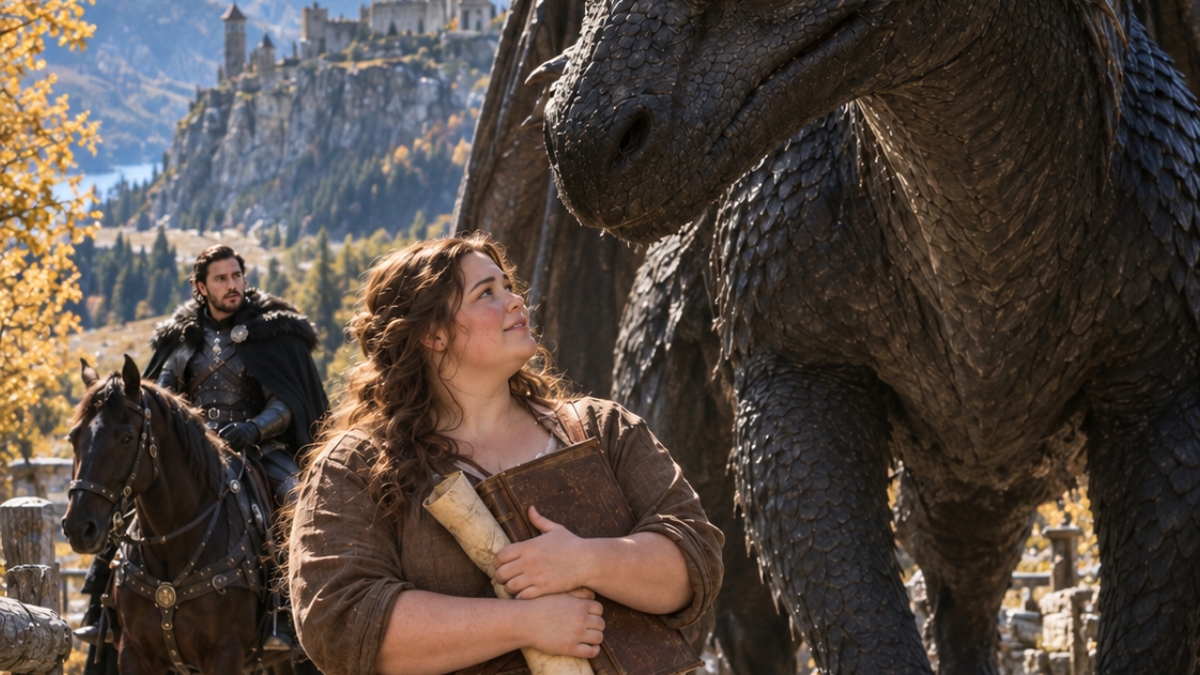
She had spent the night climbing a mountain, riding a dragon she had once been told she was too heavy to touch, breaking open a stolen waterway, and returning before sunrise.
Now there was only one thing left to do. Prove it. “Two cups,” she said.
Malander laughed. The marshal did not. One cup was filled from the cistern. The second came from the old stone mouth of the Maiden’s Race, where clean spring water was suddenly pouring into the dragon yard for the first time in two years.
People began whispering. Malander went pale. Maben removed a small jar of crushed oak galls from her satchel and dropped a pinch into each cup.
The spring water became the color of weak tea. The cistern water turned gray. Then black.
The marshal stared at it. Maben explained what the reaction meant. The cistern contained vitriol—the dyer’s mineral—and the intake stood downstream from the Colbeck dye works.
For two years, the dragons had been drinking contaminated river water. Tarn had never gone sour.
He had been sick. And every morning he escaped his tether for the same reason.
Maben was carrying the only clean water he could find. To prove it without words, she stepped aside.
Tarn ignored the cistern completely. He walked to the restored Maiden’s Race and drank. The yard fell silent.
Malander recovered quickly. “A trick,” he snapped. “The Race was damaged. The accounts prove we paid for repairs.”
The marshal turned toward him. “Then show me.” That was the trap. If Malander refused to produce the original ledgers, he would look guilty.
If he produced them, Maben knew exactly what should be inside. He ordered the books brought out.
The marshal opened the first ledger. Her eyes narrowed. Pages were missing. Someone had sliced entire leaves from the binding.
Malander pointed immediately at Maben. “There is your thief! She stole the pages!” The accusation might have worked.
Except Maben smiled. Not because she was safe. Because Malander had just admitted those pages mattered.
“Marshal,” she said, “I copied every one of them before they disappeared.” She described the missing entries: twenty-six payments for repairs to the Maiden’s Race, all issued to Hob Marman, mason of Highfold.
Each payment bore Marman’s hammer-and-circle mark. Malander seized on the name. “Then bring Marman here and ask him!”
A voice came from the gate. “You cannot.” Everyone turned. Brother Tobaya, the garrison chaplain, hurried into the yard clutching the chapel burial roll.
Garrow had done his part. The chaplain opened the book. There it was. Hob Marman, mason of Highfold.
Dead. Buried in the frost month of the previous winter. The marshal looked from the burial record to Malander.
Maben delivered the truth quietly. “A dead man has been repairing your water channel for nineteen months.”
Nobody laughed now. “And there is another problem,” she continued. “The Maiden’s Race never needed those repairs.”
Malander’s face emptied. Maben reached into her satchel. The iron padlock hit the table with a heavy clang.
Crossed keys flashed in the morning light. The mark of the garrison stores. Maben explained what she had found above Lantern Spring.
The Maiden’s Race was intact. Someone had blocked it with a timber gate, diverted its clean water toward the Colbeck dye works, and forced the garrison to rely on contaminated river water.
Twenty-six repair payments had been fabricated for work that never happened. The mason receiving those payments was dead.
And the gate diverting the water had been secured with property belonging to Malander’s stores.
The quartermaster opened his mouth. Commander Garrow stepped forward. This time his voice carried across the entire yard.
He admitted everything he himself had done wrong. He had signed the order approving the cistern without properly examining it.
He had accepted Tarn’s decline as age. Worst of all, he had signed the recommendation to sell the dragon because accepting that Tarn was “sour” had been easier than investigating what Tarn was trying to communicate.
Then Garrow looked toward Maben. “She was the only one who asked what he needed.”
The words hit harder than any accusation. For years, soldiers had measured dragons by obedience.
They had measured Maben by her body. Both judgments had failed for the same reason.
Nobody had bothered to ask the right question. The marshal picked up the bill of sale.
The quarry handlers watched. Malander watched. Garrow did not breathe. The marshal tore the document in half.
Then she tore it again. The pieces fell onto the table. The quarry company would be paid for its wasted journey.
Tarn was staying in Highfold. Then the marshal faced Malander. “Your keys.” For the first time, the quartermaster’s hand shook.
He surrendered them. But Maben’s victory was not complete yet. Soldiers searched Malander’s quarters. Inside a book of sermons they found the missing ledger leaves, carefully folded and hidden.
Beneath the floorboards they discovered a purse filled with Colbeck silver. The dye works owner confessed before the soldiers had finished searching.
Clean spring water was valuable for producing certain colors. Someone inside the garrison had realized the Maiden’s Race could be secretly diverted and sold while everyone was told the channel had collapsed.
The false repair payments concealed the fraud. The cost had been paid by creatures who could not explain what was happening.
Tarn. The green dragon. And eventually, perhaps, every dragon in Highfold. Malander had almost escaped because everyone believed the easiest explanation.
The dragon was old. The dragon was sour. The dragon was disobedient. The copyist was troublesome.
The large woman wanted attention. Every assumption protected the lie. One simple question destroyed it.
Why? Why did Tarn refuse the cistern? Why did he follow Maben? Why did her ink react strangely?
Why was a supposedly broken waterway consuming money month after month? And why was a dead mason still signing receipts?
The dragons did not recover overnight. Clean water could stop the damage, but it could not instantly erase two years of it.
Within a week, the young green began eating again. Tarn took longer. For weeks, the gray remained around his scales.
His wings strengthened slowly. His fire still refused to return. Then, one freezing morning, shouting erupted from the dragon yard.
Garrow came running. Maben came running. For one terrible second, everyone thought something had happened to Tarn.
Instead, they found a burning bale of hay. Tarn had sneezed. And accidentally set it on fire.
Gethan, the old dragon master, laughed so hard he had to sit down. By the first snow, Tarn’s scales were black again from horn to tail, shining like wet slate.
Then came the morning everyone had been waiting for. Tarn opened his wings. He ran.
And the black dragon rose over Highfold. People poured into the streets as his shadow crossed the rooftops.
Children screamed and pointed. Soldiers who had once discussed selling him to a quarry stood staring upward.
Garrow watched his dragon circle the garrison. But Tarn’s recovery changed more than one animal’s fate.
The cistern was removed. The Maiden’s Race was inspected every month by people required to physically walk its entire length.
Water was tested regularly. The marshal issued a new order: whenever a dragon refused food, water, tack, or commands, the refusal would be documented and investigated before anyone declared the creature sour.
And she created a new position. Warden of Yard Waters and Records. The job came with a desk, authority over the water logs, and a key to the dragon yard.
The position went to Maben Pen Hallow. The copyist everyone had mocked was now responsible for protecting the very dragons she had once been told she could never ride.
But Highfold had one more old mistake to correct. Spring arrived. One afternoon, Saddle Master Ivo Stannard appeared at Maben’s tack-room office carrying the same kind of measuring cord he had carried ten years earlier.
Maben remembered him immediately. He was the man who had measured her at sixteen. The man who had looked at her body and decided her dream before she had even been given a chance.
Stannard looked older now. And uncomfortable. “I have made saddles for thirty years,” he told her.
“I was taught that the rider must be measured against the saddle.” He paused. “The commander suggested that perhaps I have been measuring the wrong thing.”
Then he lifted the cord. This time, he did not measure Maben to determine whether she deserved a dragon.
He measured Tarn. Then he measured Maben. Then he built the saddle around both of them.
It was the finest saddle he had ever made. And Tarn accepted it. There was another change in Maben’s life, though it happened more quietly.
Commander Garrow began walking her home. At first there was always an excuse. A report to discuss.
A question about an old ledger. A concern about Tarn’s water. Eventually the excuses became ridiculous enough that neither of them pretended.
On evenings when Maben worked late, Garrow sat outside her tack-room office on an overturned bucket while she taught him how to read old handwriting.
He was terrible at it. A man who could guide a dragon through mountain storms could apparently be defeated by a seventeenth-century treasurer’s letter S.
Maben found this deeply amusing. Garrow accepted the humiliation. But he never demanded anything from her.
He never treated saving Tarn as something that made Maben owe him affection. He waited.
Near midsummer, in the same lane where he had once accused her of secretly feeding his dragon, Garrow stood with his hat in his hands.
Then he asked whether he might call on her properly. Maben looked at the commander.
Then at Tarn. The dragon appeared spectacularly uninterested in helping either of them. She said yes.
But the greatest change was still waiting. One morning before sunrise, Highfold heard wings. A black dragon descended from the sky and landed in the lane outside Maben’s home.
Tarn lowered his enormous head onto the cobbles. And waited. Nobody had ordered him there.
Garrow had not sent him. There were no jugs of spring water anymore. No poisoned cistern.
No reason for Tarn to follow her. Except one. He wanted to. Maben stepped outside.
The dragon raised his head. For ten years, she had carried one sentence inside herself.
Too heavy. Too heavy for the saddle. Too heavy for a dragon. Too heavy for the dream.
But Tarn had never measured her that way. When she had fallen on the mountain, he had lowered himself.
When she climbed onto his back, he had carried her. And now, strapped securely across him, was a saddle built not for some imaginary perfect rider—but for Maben Pen Hallow exactly as she was.
She placed one foot into the stirrup. People stopped in the street. She climbed. Tarn rose.
For one suspended moment, Maben could see all of Highfold below her: the records house where nobody had noticed her, the dragon yard where soldiers had laughed at her theory, the cistern that had nearly killed three dragons, and the lane where Tarn had followed her every morning.
Then the dragon opened his wings. The woman who had been told she was too heavy to ride disappeared into the sky on the back of the most magnificent dragon in Highfold.
She had never needed to become thinner. She had never needed to become a soldier.
She had never needed to become the person other people thought a dragon should choose.
She had needed someone to stop measuring her against the wrong thing. And perhaps that was why Tarn had found her before everyone else understood.
At first, he had followed the water. In the end, when there was no water left to follow, he still came back for her.
Not because she was his commander’s copyist. Not because she had saved him. Not because anyone ordered him to.
The black dragon simply liked walking behind her. And whenever Maben wanted to fly, he waited for her to climb aboard.
Disclaimer: This story is entirely fictional and was created solely for entertainment purposes. It does not represent any organization or individual, nor does it endorse inappropriate behavior.
This content was created with the assistance of AI.








