“THAT’S ENOUGH!” THE COWBOY ROARED—AS THEY HORSEWHIPPED A WIDOW FOR THE “SINS” OF HER DEAD HUSBAND
PART 3 — WHEN THE WHOLE TOWN FINALLY STOOD UP
Eleanor threw the money into the fire.
Five hundred dollars curled black. Andrew stared. “Your father would call that wasteful.” Then he smiled.
“He married you anyway.” Eleanor was already moving. By sunrise she was inside the Dry Creek livery demanding the overnight wagon log.
The owner resisted. She did not. Finally he surrendered the book. One wagon had left near midnight.
Rented by Wade Kersey. Returned near dawn by another man. The team included a gray horse Eleanor recognized.
“Which road?” The liveryman swallowed. “South Fork.” “Where?” “mrs. Whitaker—” “Where?” “Old line shack near Bitter Wash.”
Eleanor found Boone outside the jail. Silas stood behind the bars inside. “Bitter Wash,” she said.
Boone understood immediately. He summoned Sheriff Dyer. Sixteen miles later, they found the shack hidden behind a ridge.
Martha Bellamy was inside. No chains. No bruises. No locked door. She had not needed them.
Fear had been enough. One of Voss’s men guarded her. He surrendered when Sheriff Dyer appeared.
Martha began crying. “I signed the statement.” “I know.” “He said my niece would lose the farm.”
“I know.” Eleanor took her hands. “Will you tell the truth now?” Martha looked at the sheriff.
At Boone. Then at Eleanor. “Yes.” The practice-signature sheet had been burned. Their strongest physical evidence was ashes.
But Martha was alive. And willing to testify. Still, Eleanor knew something was missing. A witness could be attacked.
A ledger could be called mistaken. A map showed motive, not forgery. They needed one final connection.
That night Andrew arranged Samuel’s ledger entries by date. “These changes begin August fourth.” Eleanor nodded.
“When did Father become too sick to manage the books?” “Late July.” “Exactly when?” She froze.
A memory crashed into place. Dr. Amos Bell. August first. Samuel sweating in bed. The doctor leaving.
Harlon Voss arriving later that same day carrying peaches. A friendly visit. Or so Eleanor had believed.
They found Dr. Bell three streets behind the courthouse. He was old. His hands shook.
His memory did not. “Yes,” he said. “I spoke with Voss.” “What did he ask?”
The doctor frowned. “About Samuel’s condition.” Eleanor leaned forward. “What exactly?” “Whether the fever could affect Samuel’s judgment.”
Boone stopped writing. “What else?” “He asked when Samuel might become unable to understand his accounts.”
Nobody moved. Eleanor felt her pulse hammering. “And?” Dr. Bell hesitated. “He asked whether a man in Samuel’s condition could later dispute something he’d signed.”
Silence. Andrew opened the ledger. August first. Voss questioned the doctor. August fourth. The altered accounts began.
Three days. Boone slowly closed his notebook. Now they had intent. The following morning Silas walked free.
The old warrant had collapsed under examination. The allegations came from a real and ugly episode in his past, but the renewed warrant had been built on a statement contradicted by county records.
Eleanor waited across the street. Silas saw her. Stopped. Neither spoke for several seconds. Finally he said, “Martha?”
“Safe.” “The case?” “Alive.” He nodded. Then Eleanor asked, “Why didn’t you tell me everything about Shaw?”
Silas looked toward the dirt. “Cowardice.” No excuse. No polished explanation. Just the word. Eleanor studied him.
Then nodded toward the courthouse. “You can make yourself useful.” A faint smile appeared. They walked together.
Harlon Voss was waiting behind the courthouse. Wade stood nearby. Voss looked exhausted. But not afraid.
Not yet. He looked at Silas. “You always did prefer other people’s battles.” Silas said nothing.
“Tell her how many men you frightened off land.” Silas’s hand drifted toward his Colt.
Voss smiled. There it was. His final trap. A gunfight. If Silas killed him, Voss became the victim.
If Voss killed Silas, the most dangerous man against him disappeared. Either way, the evidence would drown beneath blood.
Silas’s fingers tightened. Eleanor saw it. “Silas.” He looked at her. She remembered Main Street.
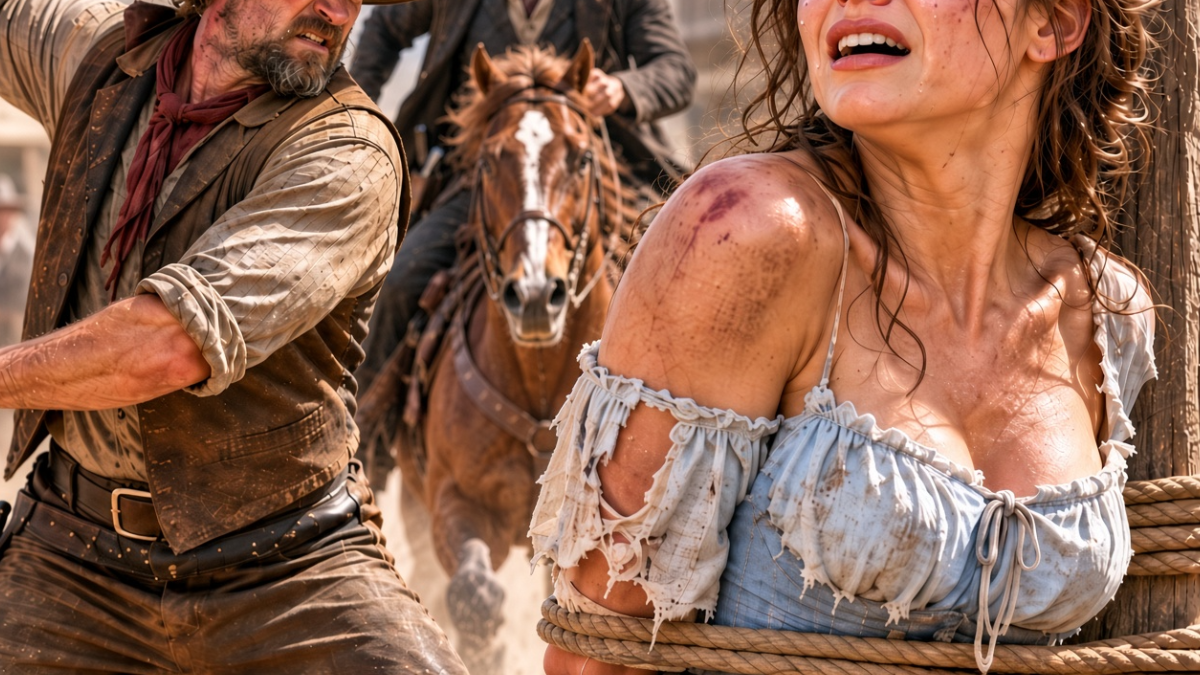
The rope. The whip. The moment one stranger had stepped out of a silent crowd.
Now she returned his own words. “That’s enough.” Silas stared at Voss. Then slowly moved his hand away from the gun.
Voss’s smile vanished. Sheriff Dyer stepped between them. “The court is waiting.” The courtroom overflowed.
Farmers stood against the walls. Women packed the benches. Men who had watched Eleanor tied to a post now strained to hear every word.
Judge Warren Alderton entered. Boone rose. “This case is not about whether Samuel Whitaker ever borrowed money from Harlon Voss.
He did.” Voss’s attorney looked surprised. “This case is about whether mr. Voss altered those debts after Samuel Whitaker became too ill to challenge them, forged documents to obtain property he needed for a commercial corridor, and used intimidation to force Samuel’s widow into surrendering that property.”
The judge looked over his spectacles. “That requires considerable proof.” Boone nodded. “Yes, Your Honor.”
Then the witnesses came. Mabel Henshaw described Voss’s bookkeeping practices. Ezra Cobb testified that he had seen Wade Kersey cutting Eleanor’s fence.
Then Martha Bellamy walked to the stand. Harlon’s face finally changed. Martha told the court everything.
The altered accounts. The copied signature. The threats. Her disappearance. The false recantation. Voss’s lawyer attacked immediately.
“No one kidnapped you physically, correct?” “No.” “You left voluntarily?” “Yes.” “You signed the statement voluntarily?”
Martha hesitated. “Yes.” The attorney sensed blood. “So your allegation of coercion amounts merely to mr. Voss reminding you that your niece’s family owed a legitimate debt?”
Martha looked frightened. For one second. Then something hardened inside her. “When a man has spent ten years proving he can destroy families with debt, he doesn’t need a pistol.”
The courtroom went silent. Judge Alderton wrote something down. Andrew came next. He produced the property map.
One acquisition. Then another. Then another. Eleven disputed properties. All forming a corridor toward the proposed rail spur.
With the Whitaker ranch sitting in the only remaining gap. Motive. Then Eleanor took the stand.
Voss’s attorney approached. “These ranch records were maintained by you?” “Yes.” “So they aren’t independent records.”
“No.” “You hate mr. Voss?” “I do now.” Murmurs rippled through the room. “So you admit bias?”
“I admit experience.” The judge hid something that almost resembled a smile. The lawyer continued.
“Your husband was sick?” “Yes.” “Confused?” “Sometimes.” “Forgetful?” “Near the end.” “So Samuel could have failed to record debts.”
Eleanor looked straight at him. “He could forget breakfast. He could not unpay money already paid.”
Laughter broke out. The judge silenced it. The attorney held up the disputed agreement. “Yet we have Samuel Whitaker’s signature.”
“No.” Eleanor’s voice remained calm. “You have a drawing of it.” “Are you a handwriting expert?”
“No.” “An attorney?” “No.” “Then why should this court accept your interpretation?” Eleanor reached into her bag.
And pulled out a receipt. Silas’s sixty dollars. The money she had resented. The interference she had never requested.
The receipt Voss himself had written after Silas stopped the whipping. Boone entered it into evidence.
Eleanor spoke. “mr. Voss claimed I owed $480 that morning.” “Yes.” “mr. Rourke paid sixty.”
“Yes.” “What balance did mr. Voss personally write on that receipt?” The attorney looked. “Four hundred twenty dollars.”
“And what amount did mr. Voss file with the county recorder less than twenty-four hours later?”
Boone handed him the second document. The lawyer’s face tightened. “Six hundred thirty.” The courtroom stirred.
Eleanor did not look away. “How much money did I borrow from mr. Voss overnight?”
No answer. “How many cattle did I purchase from him?” Silence. “What service worth $210 did he perform?”
Nothing. Judge Alderton leaned forward. For the first time, Voss looked uncertain. Then Dr. Amos Bell testified.
He gave the date. August first. He repeated Voss’s questions about Samuel’s mental clarity. His ability to understand financial documents.
His ability to challenge a signature. Boone placed Samuel’s ledger before the judge. “The first unexplained alteration appears August fourth.”
Judge Alderton looked down. Then up. “Three days later.” Boone sat. There was nothing more to say.
Voss’s lawyer tried. Coincidence. Accounting errors. Unreliable memories. Normal business practices. Missing physical evidence. Technically respectable arguments.
But now they sounded like what they were. Pieces trying desperately not to form a picture.
Judge Alderton removed his spectacles. “This court recognizes lawful debt.” Eleanor stopped breathing. “It does not manufacture it.”
Silence swallowed the room. “The claim against the Whitaker property is dismissed.” Eleanor shut her eyes.
Only for a second. “The alleged balance is void. Evidence concerning forged documents, coercive collection practices, witness interference, and related property transactions will be referred for further investigation.”
Andrew reached for his mother’s hand. This time Eleanor held it. “The Whitaker title remains with Eleanor Whitaker.”
Eight months. Eight months of grief. Fear. Bills. Threats. Humiliation. Two lashes in front of a town that had forgotten how to move.
And suddenly the weight had nowhere left to press. Sheriff Dyer approached Voss. Voss rose.
He looked at Eleanor. No apology. No remorse. “You think this ends anything?” Eleanor looked back at him.
“It ends what you get to call yours.” Then the sheriff led Harlon Voss away.
Outside, Dry Creek erupted. People surrounded Eleanor. She wanted none of it. Reverend Pike approached with his hat in his hands.
“I owe you an apology.” “No.” He stopped. Eleanor pointed across the street. At the hitching post.
The same post. The same scar from the rope. “Next time someone is tied there, Reverend, don’t wait for a stranger.”
Pike lowered his eyes. “I won’t.” “See that you don’t.” Wade Kersey vanished that afternoon.
Three days later he returned with a lawyer and offered testimony to the territorial prosecutor.
Maybe it was courage. Maybe self-preservation. Sometimes the difference only mattered afterward. Voss’s accounts were investigated for months.
Families recovered money. Old property transfers were challenged. The freight consortium dropped Voss’s company. The railroad corridor moved elsewhere.
Not every wrong was repaired. Some records were gone. Some families had moved. Some money would never return.
Justice was not clean. But Voss’s machine had stopped. That mattered. Andrew remained at the ranch until Monday.
The night before leaving, Eleanor found him packing. “You’re going back to Denver.” He looked uncertain.
“Do you want me to stay?” “No.” That surprised him. She sat beside him. “I wanted you home when your father died.”
Andrew stopped packing. “I thought you didn’t.” “I wanted you home every day.” “Then why did you make me stay?”
“Because wanting my son beside me and wanting my son to have a future were two different things.”
Andrew sat down. “I was angry.” “I know.” “I still am. A little.” “Reasonable.” He smiled.
“You always say that when you think I’m wrong.” “Not always.” “Most of the time.”
That finally made her smile. “Go back. Finish law school.” “I will.” “And when you’re a lawyer, charge people enough that your mother never has to hear about it.”
He laughed. Then his expression softened. “Father would have been proud of you.” Eleanor looked toward the window.
For once, she didn’t answer. She didn’t have to. Andrew rode away Monday morning. Eleanor watched until he disappeared beyond the cottonwoods.
Then she returned to work. That was how healing arrived. Not with music. Not with some grand declaration.
With fences. Ledgers. Cattle. Coffee. Ordinary things becoming possible again. Martha stayed in Dry Creek and found bookkeeping work.
Reverend Pike preached a sermon about cowardice that made half the town uncomfortable. Ezra Cobb continued telling everyone, loudly, that he had known Voss was crooked all along.
Nobody believed him. And Silas Rourke? Silas did not leave. Not that week. Not the next.
Eleanor never asked why. One cool September morning, she entered the barn carrying two cups of coffee.
Silas sat at Samuel’s old workbench repairing a harness. “You’re using that awl wrong.” Silas inspected it.
“Seems to be making a hole.” “An ugly hole.” “Still a hole.” She took the tool from him.
Showed him. He watched. Then nodded. “You’re right.” Eleanor raised an eyebrow. “That sounded painful.”
“Don’t get used to it.” He took his coffee. Outside, cattle moved quietly through the pasture.
A hammer struck a fence post in the distance. The ranch sounded alive again. Eleanor leaned against the workbench.
“Cheyenne is still where you left it.” “Last I heard.” “You planning on getting there?”
Silas looked through the barn doors. A long silence. Then: “Not today.” Eleanor nodded. “Good.”
Silas looked at her. “Is that an invitation?” “It’s practical geography.” For the first time, she saw him smile without hiding it.
Eleanor picked up her coffee and walked toward the sunlight. Behind her, Silas returned to the harness.
Neither asked what tomorrow meant. Some promises were stronger before they were named. Months earlier, Silas Rourke had stopped a horsewhipping with three words.
“That’s enough.” But Eleanor Whitaker had stopped something larger. She had stopped a powerful man from deciding that fear could become truth simply because enough people were afraid to contradict him.
Harlon Voss had believed debts could be invented. Signatures could be copied. Witnesses could be frightened.
A widow could be humiliated. And an entire town could be trained to look away.
He had been right about almost all of it. Almost. Because eventually one cowboy stepped forward.
Then one widow refused to sign. Then one frightened bookkeeper spoke. Then a doctor remembered.
A son found a map. A lawyer followed the numbers. And a silent town finally discovered its voice.
Harlon Voss had spent years counting on fear. Eleanor Whitaker simply counted better.
Disclaimer: This story is entirely fictional and created for entertainment purposes only. It does not represent any organization or individual, nor does it encourage inappropriate behavior. The content was generated with AI assistance.








