“You Carried Her Through Your Door. Now She Is Your Wife.” — Tom Ashby Lowered the Rifle He Had Raised at Eight Apache Riders

PART THREE — “I WAS NEVER YOURS TO TAKE”
The flash was metal. Tom moved before he could think.
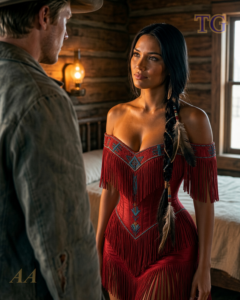
But Scandou did not draw a gun. He pulled a knife. Not toward Tom. Toward the leather strap holding a small bundle behind his saddle.
One slash. The bundle fell. Scandou kicked it across the dirt toward Dahteste. She stared down at it.
Tom stopped. Nantaje did not. The older man stepped between them and spoke sharply. Scandou answered with fury.
Dahteste’s face hardened. “What is it?” Tom asked. “Gifts.” “For what?” “The things he once brought when he asked my family for permission to marry me.”
Scandou pointed at the bundle, then at Dahteste. His words came faster. Bitter. Accusing. Dahteste listened until he finished.
Then she stepped forward. She did not stand behind Tom. She did not look toward Nantaje for permission.
She faced Scandou herself. And spoke. Her voice was low at first. Then stronger. Scandou interrupted.
Dahteste cut straight across him. He stopped. Even Tom, who understood almost none of the words, understood what had just happened.
For once, Scandou was being forced to listen. Dahteste finished. Silence swallowed the spring. “What did you tell him?”
Tom asked. She never looked away from Scandou. “I told him he keeps speaking as though you took something from him.”
She paused. “I told him I was never his to lose.” Scandou’s jaw tightened. Dahteste took another step.
“I told him my uncle refused him. I refused him. He heard both answers and decided they meant nothing.”
Scandou looked toward Nantaje. The older man said nothing. There was no rescue waiting there.
No reinterpretation. No second negotiation. Dahteste continued. “And I told him that you carried me into your house without knowing any custom.
But when you learned what it meant, you asked what I wanted.” Tom felt something tighten in his chest.
Scandou looked at him. Then back at her. “And?” Dahteste finally turned toward Tom. The anger disappeared from her expression.
What replaced it was quieter. More dangerous to him than anger could ever have been.
“I told him that by the time you knew what carrying me through that door meant, I had already decided you were a man worth staying with.”
Tom forgot Scandou. Forgot Nantaje. Forgot the cold. For several seconds there was only Dahteste standing beside the spring where he had once found her barely alive.
“I didn’t know what I was doing that morning,” Tom said. “I know.” “I do now.”
Her eyes held his. “I know that too.” Scandou climbed onto his horse. This time he did not threaten Tom.
He looked at Dahteste once. She did not lower her eyes. Then he rode south.
He never looked back. Tom watched until the dust disappeared. Only then did he realize Nantaje was standing beside him.
The older man placed one hand on Tom’s shoulder. Briefly. Firmly. Then he spoke. Dahteste smiled.
“What?” “He says you should visit the camp before winter.” “Why?” “Neechee wants to meet you.”
“The healer?” “My teacher.” Tom looked suspicious. “Why do I have the feeling I’m facing another test?”
Dahteste’s mouth twitched. “Because you are learning.” They walked home together. Not Tom first. Not Dahteste behind.
Together. That mattered. Weeks earlier, a custom neither of them had chosen had tied their lives together.
But somewhere between the corrected irrigation channels, shared coffee, repaired walls, and that morning at the spring, something far stronger had replaced obligation.
Choice. They went to the Chiricahua camp before the first frost. Nantaje had sent Dahteste a horse, so she rode beside Tom instead of behind him on Deuce.
Tom noticed she seemed different as the camp came into view. Lighter. Voices called to her.
Children ran past. Older women embraced her. For the first time, Tom saw Dahteste not as the mysterious woman who had appeared half-dead beside his spring, but as someone rooted deeply in a world that existed long before he entered it.
And he suddenly understood something uncomfortable. He had spent weeks wondering whether she belonged in his life.
He had rarely asked whether he could belong in hers. Then Neechee appeared. She was tiny.
Old. And she looked Tom over with such ruthless concentration that he instinctively straightened his shoulders.
Neechee said something. Dahteste covered her mouth. Tom narrowed his eyes. “What did she say?”
“She says your face looks honest.” “That doesn’t sound funny.” “There was more.” “Of course there was.”
“She says your hands are wrong for farming and someone should have told you before you traveled all the way to New Mexico.”
Tom stared at the old healer. Neechee stared back. Then Tom looked at his scarred hands.
“Well.” Dahteste waited. “She’s not wrong.” Neechee laughed. That broke something open. The afternoon became easier.
Tom sat beside Nantaje near a fire. Their shared vocabulary was poor, but neither man seemed troubled by it.
Sometimes understanding arrived before language. Nantaje had watched Tom when he was confused. Watched him when he was challenged.
Watched him surrender his horse. Watched him give water to a rival. And, more importantly, watched Tom stand aside while Dahteste spoke for herself.
Late that afternoon, Neechee approached Tom carrying a bundle of roots wrapped in cloth. She pushed it into his hands.
Tom looked at Dahteste. “For the well,” she explained. “What do I do?” “I will show you.”
Neechee spoke again. Dahteste became very quiet. “What?” “She says she has spent forty years learning the difference between what is real and what only looks real.”
Tom waited. “She says this is real.” The old woman walked away. Tom looked down at the bundle.
Then at Dahteste. “That was approval?” “From Neechee?” “Yes.” “That was almost enthusiasm.” He laughed.
On the ride home, October sunlight turned the foothills amber. Dahteste rode slightly ahead. Tom watched her for a moment.
“Does it bother you?” She looked over. “What?” “How this started.” She considered the question.
“With an accident?” “Yes.” “No.” Tom waited. She continued. “You saw someone who needed help.
You helped. You did not calculate what it would cost you first.” “I didn’t know there was anything to calculate.”
“That is the point.” They rode farther. The homestead appeared in the distance. A tiny structure against an enormous landscape.
Then Tom noticed something glowing in the window. The lamp. Dahteste had left it burning before they departed.
“You left the lamp on.” “Yes.” “Why?” “So there would be a light when we came home.”
Home. Tom had owned that house for more than a year. He had slept in it through winter storms.
Patched its roof. Built its walls. Nearly starved inside it during his first bad harvest.
Yet somehow he had never understood that a house and a home were not the same thing.
He understood now. Winter came hard. But the well held. The root cellar was full.
The corrected field had taught Tom enough that he already knew what he would change the following spring.
And before the deepest cold arrived, Tom and Dahteste built another room against the south wall.
They worked side by side. Tom set stone. Dahteste checked the line. They argued about the window.
“It should face south,” Tom insisted. “East.” “South gets more light.” “East.” “Why east?” “So morning enters first.”
Tom stared at her. Then he cut the opening in the east wall. Nantaje visited twice that winter.
The first time he brought dried meat. The second, a leather tool collar. His English improved.
Tom’s Chiricahua vocabulary improved too, although Dahteste still occasionally laughed so hard at his pronunciation that she had to turn away.
The house changed. Coffee for two. Two sets of footsteps. Medicinal plants drying near the new east window.
Tom’s tools hanging where he could actually find them because Dahteste had finally declared his previous system “not a system.”
And there were evenings. Those mattered most. Lamp low. Wind outside. Dahteste working with plants or beadwork.
Tom repairing harness or reading his almanac. Neither needing to fill the room with words simply to prove they were together.
Then spring came. A letter arrived from Ohio. Tom’s younger sister. He sat at the table for an hour before answering.
Usually his letters home were painfully short. Weather. Corn. Horse. Still alive. This one became four pages.
He told his sister the land was improving. He told her he had learned more about irrigation in six months than in his first year.
He told her there was someone living beside him now. He started explaining the marriage.
Stopped. Started again. Finally, he wrote only: Things happened differently than I expected. Six weeks later, his sister’s reply arrived.
Tom read one sentence twice. Then handed the letter to Dahteste. She read it slowly.
His sister had written: “I’m glad you found someone to be alongside. That’s the only kind of company worth having.”
Dahteste returned the letter. “Your sister is wise.” “Don’t ever tell her that.” “Why?” “I have to live with having known her since childhood.”
Dahteste smiled. A year passed. The homestead changed again. The corn stood taller. The well was deeper.
The south fence finally stopped leaning. The room with the east-facing window became Dahteste’s place for medicines, roots, dried leaves and the work Neechee continued teaching her.
People began coming. First members of her own community. Then a ranch hand with an infected cut.
Then a settler’s child burning with fever. Tom watched Dahteste work with the same calm certainty she had shown when treating his cracked knuckle.
Some visitors were uncomfortable when they first arrived. Some stared. A few said things Tom disliked.
But desperation has a way of stripping prejudice down to its useless bones. When someone they loved was sick, they came.
Dahteste helped when she could. She never demanded gratitude. Tom never demanded acceptance. Their life simply continued.
One evening, almost exactly a year after he had found her, Tom walked down to the spring.
Dahteste was already there. She sat on one of the flat stones beside the water.
For a moment, the sight stopped him. Same spring. Same September air. But everything else was different.
Dahteste heard him. “You are staring.” “I’m remembering.” “The day you found me?” Tom sat beside her.
“I thought you were dead.” “I nearly was.” “I remember picking you up.” She looked at him.
“And?” “I remember thinking you weighed almost nothing.” “That is romantic.” “I wasn’t finished.” “You should have stopped there.”
Tom smiled. Then his expression changed. “I remember crossing the doorway.” Dahteste became quiet. “I had no idea.”
“No.” “If somebody had stopped me and said, ‘Tom, carrying this woman inside may change the rest of your life,’ do you know what I would have done?”
“What?” “I would have carried you inside anyway.” She studied him. “Because I was sick?”
“Because you needed help.” She nodded. Tom looked across the water. “But if somebody had told me everything else…”
“The marriage?” “The challenge. Scandou. Nantaje watching me like he was deciding whether a roof beam would collapse.
Neechee insulting my farming hands.” Dahteste smiled. “All of it.” Tom took her hand. “I’d still carry you through that door.”
This time she did not joke. “Why?” Tom looked at the woman who had transformed his failing claim without ever asking permission to transform him.
“Because carrying you inside was an accident.” He tightened his fingers around hers. “Choosing you afterward wasn’t.”
Dahteste looked down at their hands. Then toward the house. From the spring they could see the east window.
The window she had insisted upon. The last sunlight touched it. Tomorrow morning, it would be the first part of the house to catch the dawn.
She stood. Tom rose with her. They walked back together. When they reached the doorway, Dahteste stopped.
Tom nearly walked into her. “What?” She turned. There was something mischievous in her eyes.
“Do you remember the first time you carried me across this threshold?” “Yes.” “You did not ask permission.”
“You were unconscious.” “Still.” Tom crossed his arms. “All right. What are you suggesting?” She lifted her arms slightly.
Tom stared. Then laughed. “You cannot be serious.” She waited. Tom shook his head. Then he bent, lifted her into his arms and carried her across the threshold again.
This time Dahteste was awake. This time she was laughing. This time Tom knew exactly what he was doing.
And this time no custom, uncle, rival, test or misunderstanding was required to tell either of them what the act meant.
He set her down inside. Dahteste kept her arms around his neck for another moment.
“You asked what I wanted when no one else did,” she said. Tom looked at her.
“And what do you want now?” She glanced around the house. At the two coffee cups.
At his tools. At her medicines. At the doorway behind them. Then at him. “This.”
Outside, the foothills darkened. Coyotes began calling somewhere beyond the field. The well held. The corn waited for harvest.
And morning would come through the east window first. Tom Ashby had once believed the most important thing he could build in New Mexico was a successful claim.
He had been wrong. The most important thing he built had begun with a dying stranger beside a spring, an act of kindness he never stopped to calculate, and a threshold he crossed without understanding what waited on the other side.
The custom may have named them husband and wife. But the life that followed was built differently.
Cup by cup. Stone by stone. Question by question. Choice by choice. And if anyone had asked Tom, years later, when he had truly married Dahteste, perhaps he would not have said it happened on the morning he carried her through his door.
Perhaps he would have remembered another morning. A rival riding toward his spring. His own horse being handed away.
Water offered freely. And Dahteste standing nearby—not as something to be won, surrendered, protected, or possessed, but as the person who had chosen to stand there.
Or perhaps he would have remembered an ordinary evening much later, when she raised her arms at the doorway and allowed him to carry her across it one more time.
Because the first time, Tom had carried her inside to save her life. The second time, he carried her inside because they had already chosen a life together.
And that made all the difference.
Disclaimer: This story is entirely fictional and created for entertainment purposes only. It does not represent any organization or individual, nor does it encourage inappropriate behavior. The content was generated with AI assistance.








