LEFT TO ROT AT THE STATION—UNTIL A RANCHER LOOKED AT HER AND SAID, “YOU BELONG WITH ME”
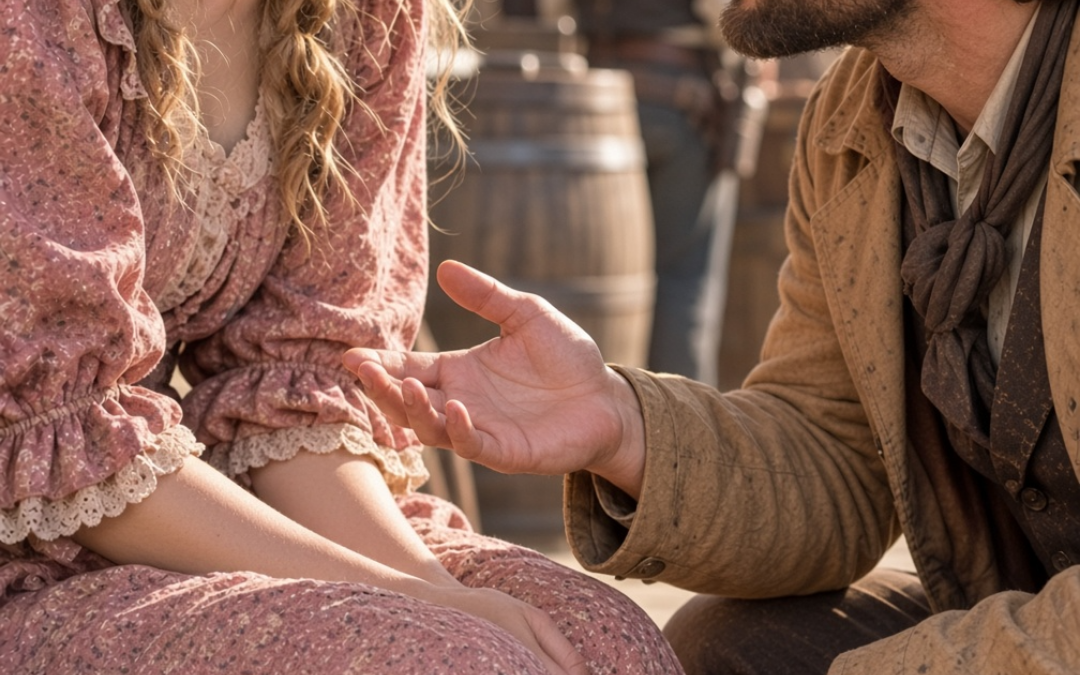
PART TWO — HE CAME TO TAKE THE RANCH… BUT HE NEVER EXPECTED HER TO FIGHT BACK
Nathan Cole did not wait long. First came the rumors. Clara was not Samuel Carter’s employee, people whispered.
She was his kept woman. Nathan spread the story carefully because he understood exactly what reputation could do to a woman in a small frontier town.
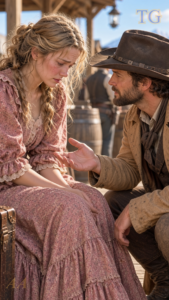
If Clara became socially ruined, anything she later said about his letters or his land scheme could be dismissed.
Clara saw the trap. And refused to hide. She went into Harland Creek. She worked at a community supper.
She introduced herself openly as Carter Ranch’s house manager and a former Missouri schoolteacher. She let people meet the real woman before Nathan could finish inventing the false one.
Then Nathan himself rode onto Carter Ranch. He arrived with two men. Perfect clothes. Perfect manners.
Perfect lies. “Miss Whitmore,” he said warmly. “I’m very glad to see you safe.” Clara stared at him.
“You owe me an explanation.” “I had a business emergency.” “Then tell me exactly when you decided not to come to the station.”
Silence. Nathan had expected tears. Perhaps rage. He had not expected interrogation. Clara stepped closer.
“Were any of your letters true?” His smile tightened. “I meant what I wrote.” “That wasn’t my question.”
Samuel remained behind her, silent, letting Clara fight her own battle. And she did. She exposed what she knew: Nathan’s land purchases, the coming railroad spur, his obsession with the river route, and the fact that Carter Ranch stood between him and enormous profit.
Nathan stopped pretending. He turned to Samuel and made another offer for the ranch. More money than before.
Enough to erase Samuel’s debts. Samuel answered with one word. “No.” Nathan’s eyes returned to Clara.
“This ranch is failing. Carter is drowning. People who stand beside drowning men usually drown with them.”
Clara did not blink. “Or they help them stop drowning.” Nathan left. Then the real war began.
Days later, a county notice arrived. Nathan claimed an old 1879 agreement gave one of his properties superior rights to water running through Carter Ranch.
If the claim succeeded, Samuel could lose the water feeding his south herd. Without the herd, there would be no winter.
Without winter survival, there would be no ranch. Clara moved instantly. She and Samuel tore through county records until she found the flaw.
The old agreement existed—but it was non-transferable. Nathan had no legal right to use it.
Then they discovered something worse. A supporting document had apparently been forged. Suddenly Nathan was no longer simply an aggressive businessman.
He was exposed. Samuel had spent years documenting suspicious pressure on neighboring landowners, strange financial maneuvers, attempted purchases, dates, conversations.
His private record book became evidence. Judge Alderman sent the material to territorial authorities. Nathan struck back again.
This time through Samuel’s bank. A debt provision was suddenly invoked. Carter Ranch could face forced sale.
The attack should have broken Samuel. Instead, something Nathan had never understood happened around the supper table.
The ranch hands stayed. Pete. Hector. Dusty. All seven. They offered to endure reduced wages if necessary.
Samuel looked around that table and realized the ranch Nathan called “failing” contained something Nathan could not purchase.
Loyalty. That night Samuel finally told Clara about the locked room at the end of the east hall.
It had belonged to Eleanor. His wife. She had died two years earlier. She had planted the garden.
She had run the house. After her death, Samuel had simply kept moving while everything around him slowly stopped living.
Now Clara understood the neglected garden. The empty rooms. The debts. The grief inside Samuel’s silences.
And Samuel understood something too. Clara had not replaced Eleanor. She had done something entirely different.
She had brought life back to a man who had forgotten he was allowed to continue living.
But there was no time to name what was growing between them. Nathan made his most desperate move.
At three in the morning, Dusty caught a man near Carter Ranch’s water system carrying tools.
Samuel confronted him. “Who sent you?” The man hesitated. Then cracked. Nathan Cole. He claimed Nathan had ordered him to “redirect” the water.
Just temporarily. Just long enough to manufacture evidence that would support Nathan’s disputed claim. But Nathan had made one fatal mistake.
The territorial attorney, Arthur Greer, was already in Harland Creek. Now they had a witness.
At dawn, Clara and Samuel entered Judge Alderman’s office with the record book. Greer questioned them for two brutal hours.
Then he looked at Clara. “The letters Nathan Cole sent you. Do you still have them?”
Her breath stopped. “All seven.” “Bring them.” Clara suddenly remembered the fifth letter. Nathan had described the valley.
The river. Its future importance. What she had once mistaken for a prospective husband sharing his dreams now looked like something entirely different.
A businessman describing the prize he intended to acquire. And Clara had been part of his strategy.
Her humiliation became evidence. Her seven letters became a weapon. The forged water document, the manipulated bank procedure, Samuel’s records, the attempted interference with the water supply, and Clara’s correspondence created a pattern Nathan’s money could no longer easily bury.
Territorial authorities served him that afternoon. Nathan hired lawyers. But his power was already cracking.
Three weeks later, rather than risk everything at trial, his lawyer negotiated a settlement. The fraudulent water claim was surrendered.
Several pressured landowners received financial settlements. Nathan was barred for years from participating in county land matters.
His railroad scheme was restructured. And Carter Ranch remained Carter Ranch. Winter came. Hard. Merciless.
But the ranch survived. Clara cut household costs. The men kept working. Samuel sold older cattle strategically instead of losing the entire herd.
And slowly—painfully—the numbers began moving in the right direction. One evening Samuel opened Eleanor’s room.
Not to erase his wife. To stop turning grief into a locked door. Then came spring.
The garden returned. Green shoots pushed through Montana soil. The house filled with voices. And Samuel finally kept the promise he had made months earlier—that when the danger was over, he would ask Clara something properly.
He found her near the garden. No dramatic speech. No seven beautiful letters. No promises of wealth.
Samuel Carter had learned that promises were cheap unless a person had already lived them.
“Clara.” She turned. He looked almost uncomfortable. That made her trust him more. “When I found you at that station, I thought I was offering you work.”
Clara smiled faintly. “You were.” “I was wrong.” Her smile disappeared. Samuel stepped closer. “You walked into this place when it was dying.
You fed the men. You brought the garden back. You fought for land that wasn’t yours.
You stood beside me when leaving would have been easier.” He paused. “I don’t want you here because you saved this ranch.”
Clara’s heart hammered. “I want you here because when you aren’t in a room, I notice.”
Silence. “I want mornings with you. Bad winters with you. Arguments about supply costs with you.
I want whatever years I have left to be years where I know you’re coming back through that door.”
Clara’s eyes burned. Samuel reached for her hand, then stopped before touching it. Just as he had stopped before taking her trunk at the station.
Still asking. Always asking. Clara placed her hand in his. Samuel closed his fingers around it.
“You came here because another man told you where you belonged,” he said quietly. “I’m not going to do that.”
She searched his face. “Then what are you going to say?” “That if you choose me…” His voice roughened.
“You belong with me because I belong with you.” Clara laughed through tears. And said yes.
They married in March. Judge Alderman performed the ceremony. mrs. Harper witnessed it. Seven ranch hands stood in their best clothes trying very unsuccessfully not to look emotional.
Clara wore the blue dress she had brought from Missouri. The same dress. But not the same woman.
The woman who had packed it had crossed half a continent because she believed a man’s promise could give her a future.
The woman wearing it now knew better. A future was not given. It was built.
In April, official confirmation arrived that Nathan’s case was finished. Samuel found Clara in the garden and handed her the letter.
She read it once. “It’s done.” “It’s done.” She folded it. Then returned to planting.
Because Nathan Cole no longer deserved another minute of her life. One year after Clara first arrived in Montana, she returned alone to Harland Creek Station to collect a package from Missouri.
The same platform waited outside. The same cold wind carried the scent of pine. The same bench stood against the wall.
Clara stopped. A year earlier, she had sat there for three days with $4.37, a Bible, and a trunk.
People had whispered around her. Nathan had abandoned her. She had believed she had reached the end of everything.
Now she was Clara Carter. Carter Ranch was alive. The garden was full. Her mother planned to visit in spring.
Seven rough ranch hands treated her kitchen table like the center of their world. And somewhere down the road, Samuel was waiting for his wife to come home.
A train whistle screamed across the valley. Clara looked once at the bench. Then smiled.
She finally understood. Nathan Cole abandoning her had never proved she was unwanted. It had only revealed that she had placed her future in the wrong hands.
Samuel had never rescued her by giving her a life. He had given her something far more valuable.
A safe place from which she could build one herself. Clara picked up her package.
She walked out of the station. Climbed into her wagon. And turned toward Carter Ranch.
Toward Samuel. Toward home. The woman who had once waited three days for a man who never came no longer waited for anyone to decide her worth.
She knew it. And as the wagon disappeared into the Montana afternoon, Clara never once looked back.
Disclaimer: This story is entirely fictional and created for entertainment purposes only. It does not represent any organization or individual, nor does it encourage inappropriate behavior. The content was generated with AI assistance.








